Every morning, IT operations teams review backup dashboards populated with reassuring green checkmarks. Backup jobs completed on schedule, gigabytes of data transferred without error, and storage targets show active retention policies. Yet when ransomware strikes or hypervisor infrastructure collapses, organizations frequently discover a painful truth: a successful backup job completion log does not equal operational data recovery.
Modern cyber threats specifically target backup infrastructure. Ransomware operators spend weeks or months performing silent reconnaissance within compromised networks, mapping storage targets, identifying backup service accounts, and poisoning recovery points with dormant malware. When adversaries initiate encryption, their first action is to wipe local snapshots, delete cloud backup targets, and destroy recovery catalogues. In this environment, relying on traditional backup verification leaves organizations exposed to catastrophic downtime and unrecoverable data loss.
Achieving true business continuity requires evolving from passive backup logging to active, verifiable recoverability—underpinned by immutable storage architectures, rigorous restore testing cadences, and actionable recovery runbooks.
Backup Success vs. Recoverability: Closing the Confidence Gap
To build an immutable resilience framework, leadership must clearly distinguish between backup success and recoverability.
- Backup Success: A technical metric indicating that a source volume was scanned, compressed, and written to a target destination without an application crash or network timeout. It confirms data movement, not data usability.
- Recoverability: An operational capability guaranteeing that backup archives can be extracted, mounted, decrypted, and brought online as functioning systems within established Recovery Time Objectives (RTO) and Recovery Point Objectives (RPO), free of undetected malware payloads.
| Metric Dimension | Standard Backup Operations | Verified Recoverability Operations |
|---|---|---|
| Primary Focus | Data ingestion and storage efficiency | Application availability and boot integrity |
| Verification Method | Volume write completion logs | Automated sandboxed boot and functional tests |
| Threat Resilience | Vulnerable to credential compromise | Protected by immutable object locking (WORM) |
| Recovery Target | In-place or primary cluster overwrite | Isolated clean-room environment prior to cutover |
| Governance Role | System administrator task | Executive tabletop & cross-functional discipline |
Takeaway: Do not mistake successful backup completion logs for disaster readiness. True recoverability requires proving that applications can boot, authenticate, and process transactions cleanly from stored media.
Modernizing 3-2-1 for Modern Threat Models
For decades, the 3-2-1 backup strategy served as the gold standard for data protection: retain 3 copies of important data, across 2 different media types, with 1 copy stored offsite. While foundational, classic 3-2-1 was designed primarily for hardware failures, power outages, and localized physical disasters—not sophisticated cyber threats capable of executing domain-wide credential attacks.
Modern business continuity demands upgrading 3-2-1 into an immutable resilience framework:
- 3 Copies of Vital Data: Maintain production data alongside at least two secondary recovery points.
- 2 Media Formats: Segregate storage targets across distinct technologies (e.g., local high-speed block storage and offsite cloud object storage) to prevent single-platform vulnerabilities.
- 1 Offsite Location: Store data in a geographically separated data center or independent cloud region to protect against regional outages.
- 1 Immutable Copy: Enforce hardware- or API-level Write-Once-Read-Many (WORM) immutability. Once written, immutable data blocks cannot be modified, encrypted, or deleted by any user account—including compromised domain administrators or backup root credentials—until the retention lock expires.
- 0 Unverified Restores: Automate daily application-level boot and integrity tests to confirm zero corruption.
By implementing S3 Object Lock in Compliance Mode or immutable air-gapped vaults, organizations ensure that even if attackers gain administrative access to the primary backup console, the underlying recovery objects remain completely untouched.
Establishing a Rigorous Restore Testing Cadence
Immutable storage guarantees that backup files cannot be deleted, but it cannot guarantee that the underlying data was clean or functionally complete when ingested. Establishing a structured restore testing cadence bridges this gap, transforming static archives into reliable operational assets.
1. Daily Automated Boot Verification
Relying on manual restoration checks is unfeasible at scale. Modern backup and recovery services must automatically spin up every backed-up virtual machine inside an isolated hypervisor sandbox, verify OS kernel launch, validate network stack initializations, and take a screenshot of the login prompt before tearing down the temporary instance.
2. Monthly Application Integrity Validation
Successful OS boots do not guarantee application health. Monthly tests should validate deep database consistency, active directory domain relationships, and database query executions. For instance, an SQL database restore check must execute synthetic queries to verify index integrity and database consistency (DBCC CHECKDB) rather than simply mounting the .mdf files.
3. Quarterly RTO/RPO Audits
Quarterly reviews evaluate whether actual restore speeds align with published business service level agreements (SLAs). If an enterprise database has grown from 2 Terabytes to 15 Terabytes, historical network restore throughput may no longer meet a 4-hour RTO. Testing validates baseline network bandwidth, storage IOPS, and decryption performance under stress.
4. Semi-Annual Full Disaster Recovery Drills
Conduct comprehensive failover simulations that transition primary operational workloads to secondary infrastructure or cloud recovery tenants. These drills evaluate non-technical dependencies, including DNS failover automation, firewall re-routing, certificate re-binding, and user authentication handoffs.
Ransomware Recovery Runbooks: Operational Execution
When dealing with active cyber incidents, restoring systems directly into production environments without verification creates immediate risk of secondary infection. A comprehensive ransomware recovery runbook provides a methodical, step-by-step path to restoration:
Step 1: Containment and Identity Isolation
Immediately isolate affected subnetworks and revoke all active domain administrative credentials, API keys, and backup service accounts. Establish an out-of-band communication network for the incident response team and secure root-level access to immutable backup repositories.
Step 2: Clean-Room Staging
Provision a completely isolated staging environment (clean room) with zero routing access to the main corporate network or internet. Restore target systems from immutable snapshots directly into this isolated staging zone.
Step 3: Forensic Preservation & Dormant Payload Scanning
Before bringing systems online, run Endpoint Detection and Response (EDR) tools, forensic scripts, and YARA rules across the isolated virtual disks to detect scheduled tasks, rootkits, or dormant malware executables planted prior to the encryption event.
Step 4: Credential and Identity Sanitation
Reset local SAM accounts, regenerate Kerberos krbtgt keys, rotate database connection strings, and reissue service certificates within the restored systems before connecting them to isolated core infrastructure services.
Step 5: Phased Cutover and Monitoring
Re-route production traffic to restored instances in phases, prioritizing mission-critical revenue and operational dependencies. Continuous telemetry monitoring must be enforced for 72 hours post-cutover to verify stability.
Executive Leadership Tabletop Exercises: Core Questions
Business continuity is ultimately an executive leadership responsibility. During a crisis, non-technical executives must make high-stakes operational and legal decisions. Organizations should regularly conduct tabletop exercises using the following strategic questions:
- Target Recovery Time Realism: Does executive leadership know the precise financial and operational cost per hour of downtime, and has IT validated that current storage architecture can meet target RTOs?
- Data Loss Tolerance: If systems must be restored to a state from 12 hours prior, what specific customer transactions or operational logs will be permanently lost, and how will business units manually reconcile them?
- Extortion and Key Compromise: If attacker accounts gain root domain privileges, can our immutable storage policies survive without executive passphrase approval or vendor support escalation?
- Decision Authority & Runbooks: Who holds formal authority to order a full infrastructure cutover during an active incident, and are current decision trees documented in offline physical format?
- Regulatory & Customer Notification: At what exact point during a recovery operation do legal, compliance, and public relations teams need to notify regulatory bodies and affected enterprise clients?
Evaluating these questions before an incident ensures that leadership operates from tested playbooks rather than high-pressure intuition.
Building End-to-End Resilience
Backup logs are simply administrative records; recoverability is an active business capability. By modernizing legacy 3-2-1 strategies with immutable object locking, maintaining continuous restore testing, and arming leadership with actionable runbooks, organizations can weather severe cyber incidents without succumbing to data loss or ransom demands.
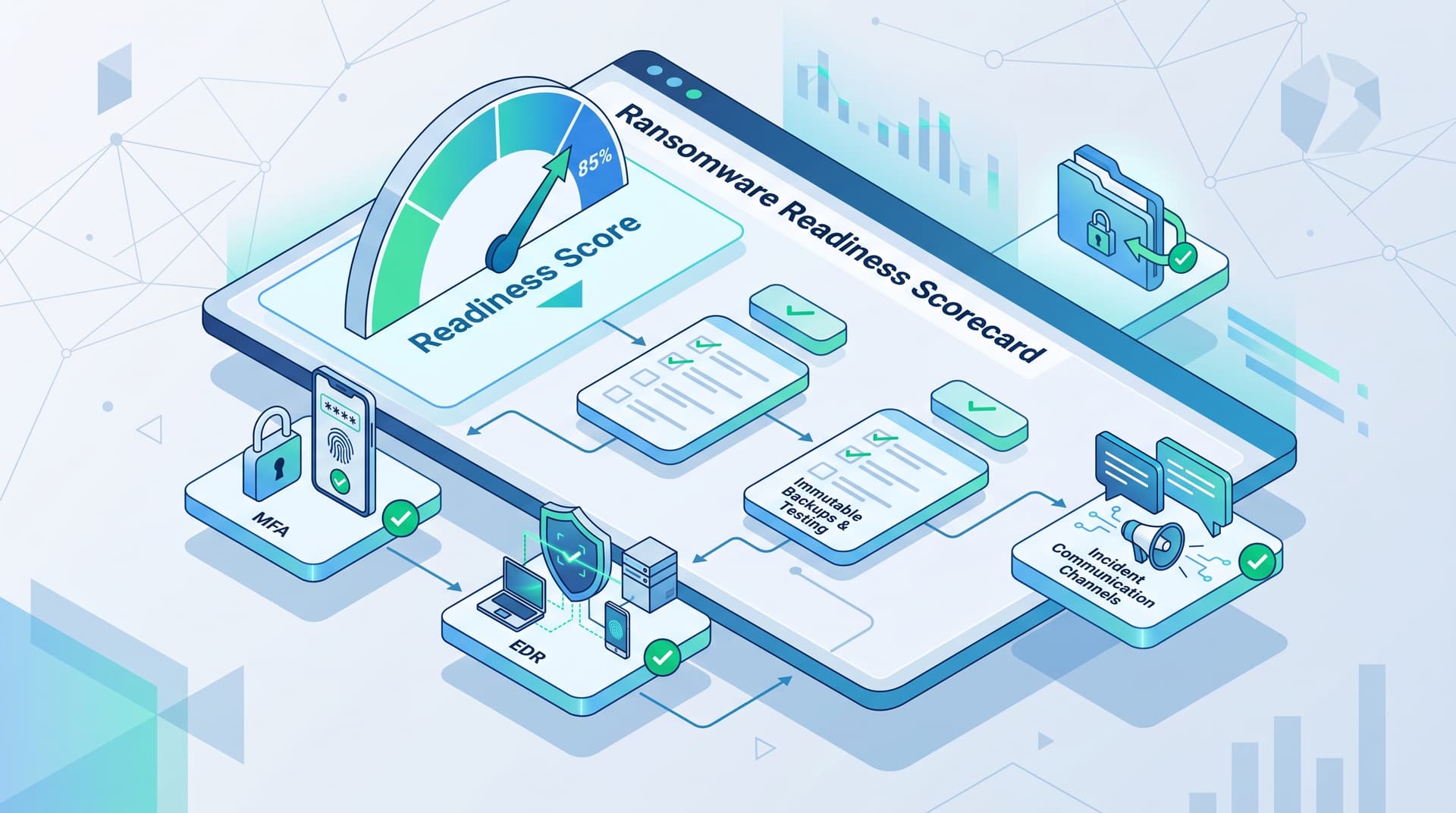
To evaluate your organization's current posture against modern cyber threats, utilize Bitscaled's Ransomware Readiness Scorecard or learn more about our managed Data Services & Infrastructure.
Ready to convert backup logs into guaranteed recoverability? Schedule a backup validation and restore test with Bitscaled to audit your recovery SLAs and establish immutable protection across your enterprise.