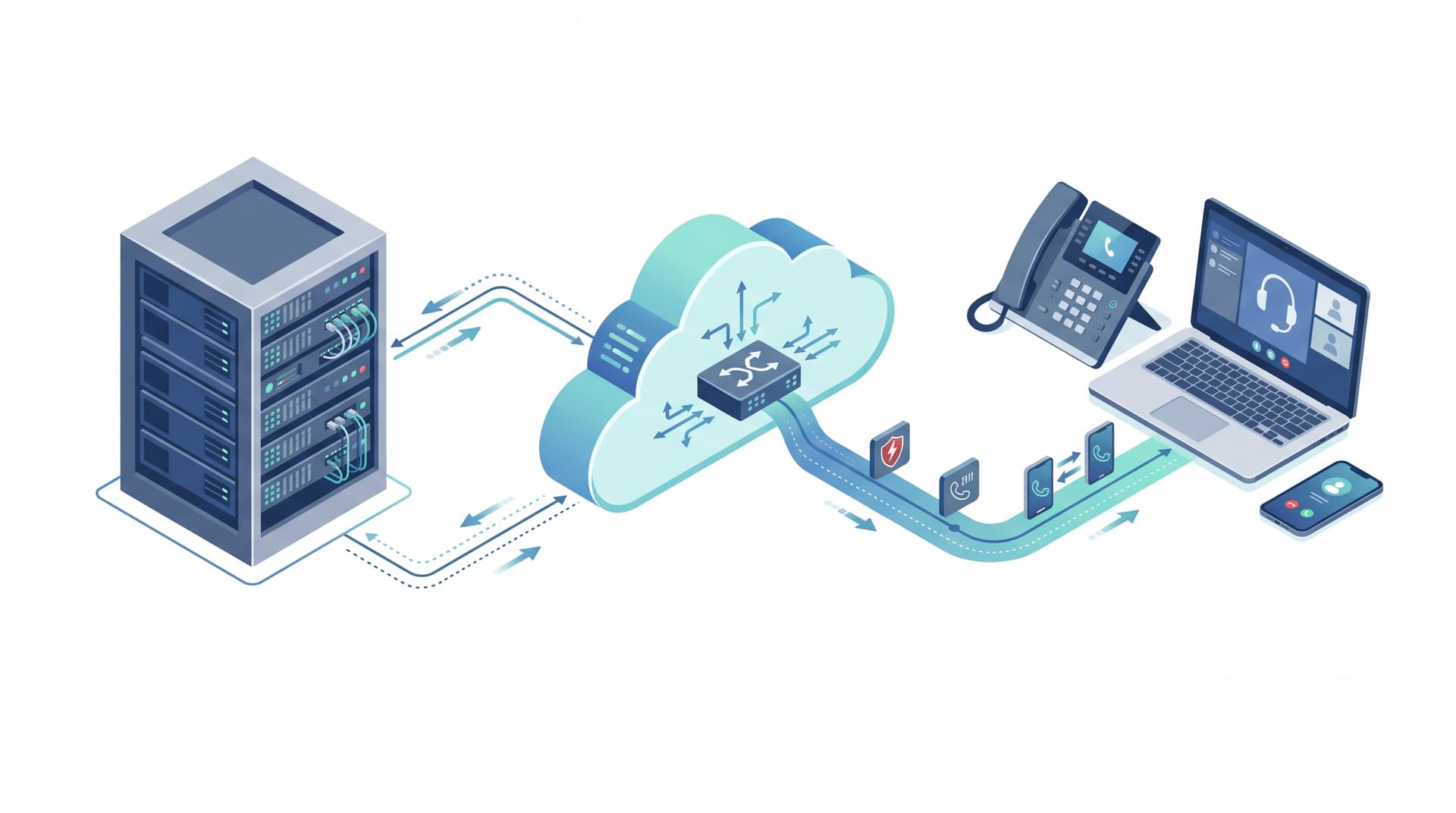
Executing a Seamless Voice Migration: On-Prem, Cloud, and Teams Phone Integration
Modernizing corporate telephony requires balancing existing hardware investments with cloud-driven flexibility. For office managers and IT leaders, shifting from aging Private Branch Exchange (PBX) systems to Unified Communications as a Service (UCaaS) or Microsoft Teams Phone isn't merely a software upgrade—it's a critical operational transition that impacts customer touchpoints, regulatory compliance, and daily workflows.
Establishing a resilient hybrid voice strategy allows organizations to move to the cloud at a measured pace without compromising reliability or emergency services. This guide outlines the key operational, technical, and regulatory considerations required for a smooth telephony migration.
On-Premises vs. Cloud Voice: Evaluating the Hybrid Model
Choosing between on-premises equipment and cloud voice systems rarely requires an all-or-nothing approach. A hybrid voice architecture bridges legacy infrastructure with modern cloud communication.
On-Premises Telephony
- Strengths: Total local control over routing, deep integration with legacy analog equipment (paging systems, door access, fax), and immunity to internet WAN outages for local extension-to-extension calls.
- Weaknesses: High capital expenditure (CapEx), complex maintenance contracts, physical hardware failure risks, and rigid scaling options for remote workers.
Cloud Voice (UCaaS)
- Strengths: Operational expenditure (OpEx) model, rapid location expansion, built-in redundancy across distributed data centers, softphone portability, and native collaboration integration.
- Weaknesses: Complete dependency on internet quality, local network bandwidth, and WAN uptime.
The Hybrid Approach
For enterprises with manufacturing floors, warehouse facilities, or strict uptime requirements, maintaining local Session Border Controllers (SBCs) or survivable branch appliances alongside cloud voice platforms provides dual benefits: local branch survival during WAN drops and central management in the cloud.
Regulatory Compliance: Mastering E911 Requirements
Emergency calling compliance is non-negotiable. Modern US regulations demand strict adherence to dynamic emergency location mapping:
- Kari's Law: Mandates direct dialing of 911 without requiring a prefix (such as dialing '9' for an outside line). It also requires automated notifications (e.g., email or screen popup) to on-site security personnel or administrative staff whenever an emergency call is initiated.
- RAY BAUM'S Act: Focuses on dispatchable locations. Emergency responders must receive precise location details beyond a static street address. For hybrid and softphone environments, this means identifying building numbers, floor levels, suites, or specific wireless access point zones.
Automated dynamic E911 systems update subscriber locations based on subnets, switch port IDs, or Wi-Fi BSSIDs as employees move throughout facilities or work remotely.
Microsoft Teams Phone: PSTN Connectivity Options
Integrating voice into Microsoft Teams streamlines collaboration into a single pane of glass. Selecting the right Public Switched Telephone Network (PSTN) connectivity method is critical to balancing cost and flexibility.
| Option | Description | Best Used For |
|---|---|---|
| Microsoft Calling Plans | Microsoft acts as the direct telecom carrier. Quickest setup, fully cloud-hosted. | Small offices, simple deployments, standardized global sites. |
| Operator Connect | Managed PSTN connectivity provided directly by participating tier-1 telecom operators via Microsoft Teams admin center. | Organizations wanting carrier SLAs and existing carrier rates without hardware management. |
| Direct Routing | Connects third-party SIP trunks and existing PBX hardware to Teams using certified SBCs. | Complex enterprises, legacy PBX integrations, analog devices, and custom rate structures. |
Carrier Logistics: Smooth Number Porting Execution
Number porting is frequently the primary cause of cutover delays. A rigorous carrier administrative process prevents lost numbers and extended cutover windows.
- Obtain Clean Customer Service Records (CSR): Request official CSRs from current carriers to verify exact billing names, addresses, service addresses, and active circuit IDs.
- Complete Letter of Authorization (LOA): Ensure signatories match carrier records exactly. Discrepancies between LOAs and CSRs cause instant carrier rejections.
- Audit Target & Partial Ports: Clearly distinguish between full account ports and partial ports (e.g., porting main numbers while keeping broadband circuits active).
- Secure Firm Order Commitment (FOC): Never schedule a cutover without an official FOC date confirmed by both losing and winning carriers.
Operational Cutover Checklist & Downtime Prevention
System failures during voice cutovers stem from predictable network and configuration bottlenecks. Identifying common failure points ensures rapid resolution.
Common Causes of Voice Downtime
- SIP ALG Interference: Application Layer Gateway features on commercial routers inadvertently alter SIP packets, causing one-way audio or dropped calls.
- DNS & Port Latency: Slow TTL resolution or blocked outbound UDP ports (5060/5061, RTP ranges) stop phone registration.
- Misconfigured Session Border Controllers (SBCs): Mismatched codecs or invalid TLS certificates break PSTN handshakes.
- Porting Delays: Early cutover before carrier FOC completion leads to orphaned inbound call routing.
Pre-Cutover Verification Checklist
- Perform bandwidth and QoS tests across all local switches and firewalls.
- Disable SIP ALG on all edge firewalls and gateways.
- Confirm emergency address routing and notification triggers for E911.
- Verify SBC TLS certificates, media bypass settings, and SIP trunk bindings.
- Complete test calls (inbound, outbound, internal extension, 911 test routing) on temp test numbers.
- Validate softphone provisioning on desktop and mobile endpoints.
Modernize Your Telephony Infrastructure
A successful voice migration requires rigorous carrier coordination, network preparation, and strict regulatory compliance. Bitscaled helps organizations design, deploy, and manage custom hybrid voice architectures that minimize downtime and optimize operational spend.
Ready to modernize your phone system? Plan a VoIP migration assessment with Bitscaled today.