Modular Operational Modernization: Driving High-Adoption Digital Change
For small and mid-sized businesses (SMBs), technology upgrades are often presented as high-stakes, binary choices. Enterprise software vendors frequently push multi-year, all-at-once ERP or CRM overhauls—commonly referred to as "big-bang replatforming." These projects promise total organizational synergy, but they routinely suffer from bloated budgets, extended delivery timelines, severe operational disruption, and poor employee adoption.
When modernizing operations, mid-market executives do not need another multi-year software boondoggle. What they need is continuous, risk-mitigated value creation. By replacing massive replatforming mandates with a modular, phased delivery strategy, organizations can modernize legacy core processes, maintain business continuity, and secure immediate operational returns.
At Bitscaled, our work in digital transformation services demonstrates that lasting transformation relies less on complete software replacement and far more on pragmatic architecture, deliberate change management, and measurable user adoption.
The Problem with Big-Bang Replatforming
Big-bang modernization attempts to replace legacy systems, data structures, and operational workflows across an entire organization in a single cutover event. While appealing on a presentation slide, this strategy carries systemic risks:
- Capital and Operational Risk: Capital remains locked up for 12 to 24 months before end-users experience any functional benefit. If business conditions shift mid-project, the software implementation quickly becomes misaligned with operational realities.
- Operational Friction: Replacing every familiar tool simultaneously forces team members to learn entirely new paradigms overnight. This leads to operational bottlenecks, missed customer deliverables, and informal workarounds outside the new system.
- Integration Complexity: Attempting to migrate years of unstructured legacy data into a brand-new architecture in a single launch exposes unseen dependencies, leading to launch delays and data corruption.
Instead of exposing the business to systemic risk, forward-thinking leaders leverage modular modernization—breaking monolithic upgrades into targeted, high-impact releases that deliver value within 60 to 90 days.
The Phased Modernization Delivery Framework
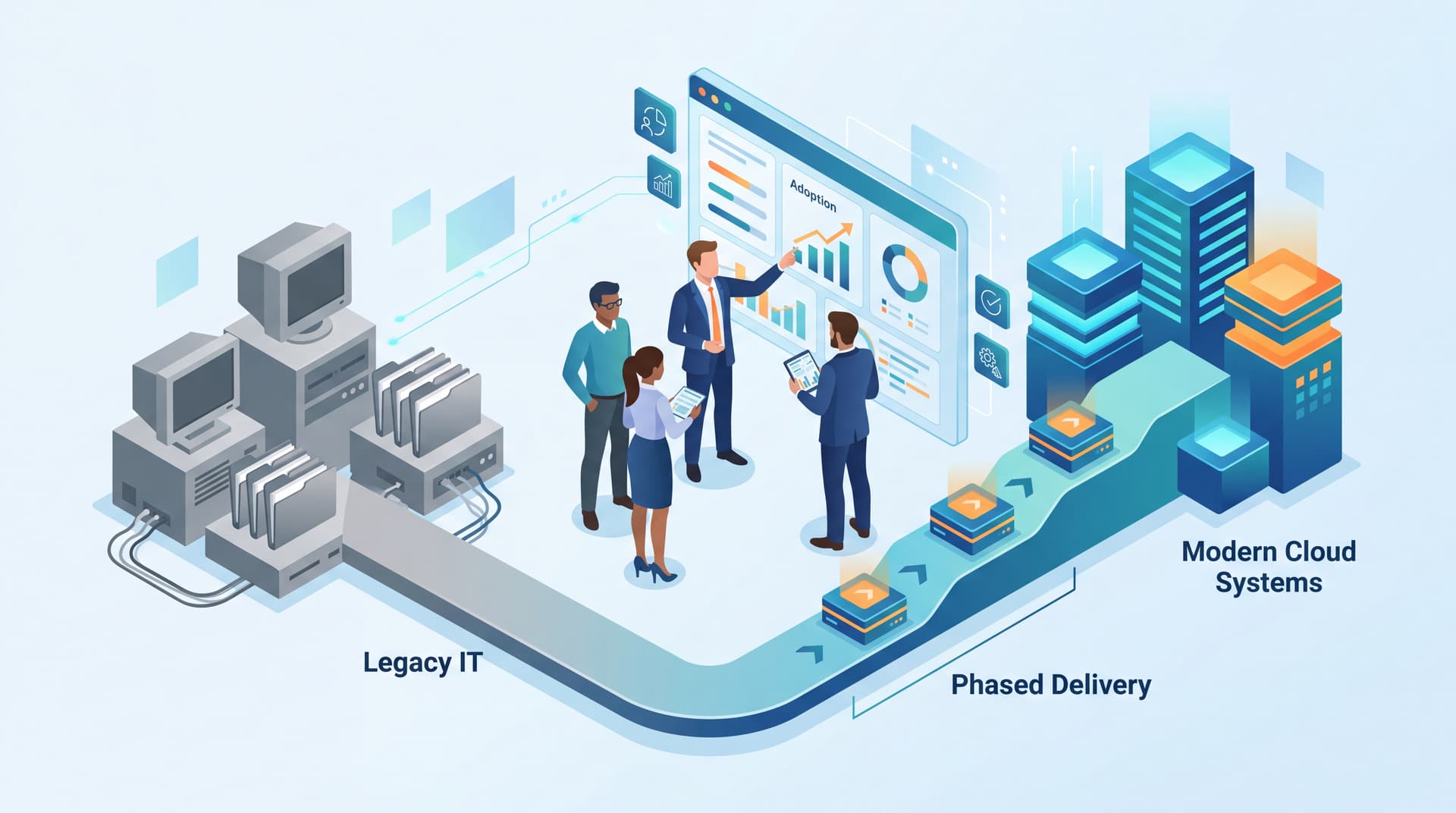
Modular modernization isolates core business workflows, builds cloud-native micro-services or API wrappers around existing databases, and updates interfaces incrementally. This preserves critical business logic while eliminating legacy debt.
Phase 1: Workflow Isolation and API Wrapping
Rather than tearing out legacy accounting, ERP, or inventory platforms, developers build lightweight API adapters. These adapters surface legacy data to modern web and mobile interfaces. Users benefit from modern tools without ripping out the reliable backend engines that power daily transactions.
Phase 2: Targeted Process Automation
Identify repetitive, error-prone manual tasks—such as re-keying data between systems or manually generating weekly reports. Implement focused workflow automations to eliminate bottlenecks before rolling out wider platform changes.
Phase 3: Incremental Component Replacement
Once modern interfaces and automated pipelines are stable, replace backend legacy components piece by piece. If an inventory subsystem requires modernization, swap only that service while keeping customer management and billing systems fully operational.
Takeaway: Incremental delivery de-risks digital transformation by delivering usable, high-value software features every few weeks rather than delaying utility for years.
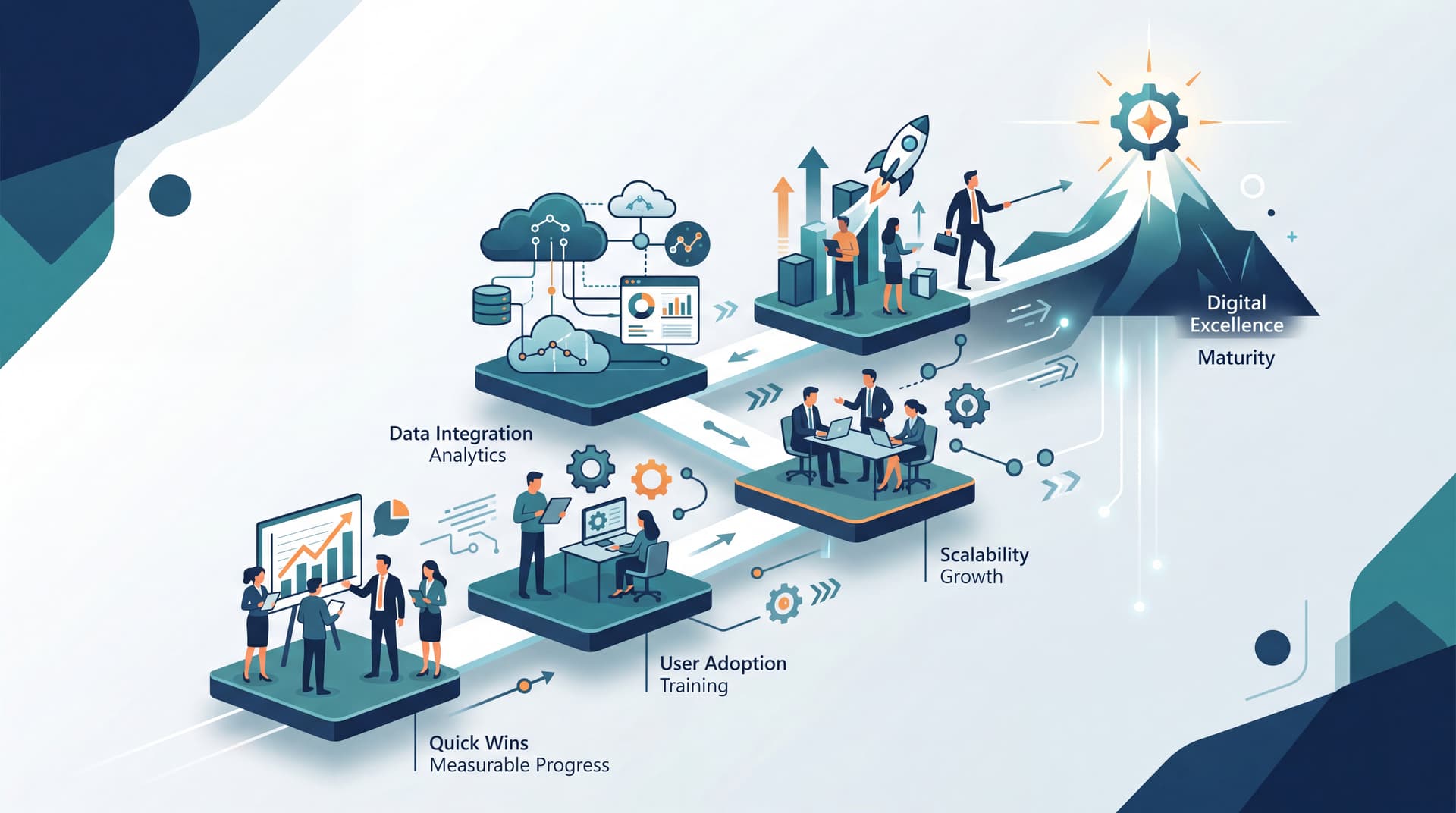
Self-Scoring Heuristic: The SMB Operational Modernization Maturity Model
Before launching a modernization initiative, leadership teams must evaluate their operational baseline. The following model is an illustrative, self-scoring heuristic designed to help executives assess current capabilities and plan realistic next steps.
| Maturity Stage | Operational Characteristics | Technology Architecture | Change Management & Adoption |
|---|---|---|---|
| Stage 1: Reactive & Siloed | Manual spreadsheet handoffs, ad-hoc task tracking, high error rates. | Monolithic legacy systems, disconnected local databases. | Minimal formal training; heavy reliance on institutional memory. |
| Stage 2: Standardized Core | Documented SOPs, centralized databases, basic digital intake forms. | Cloud-hosted servers, basic third-party software integrations. | Scheduled training sessions during rollout; baseline user guides. |
| Stage 3: Digitally Integrated | Automated cross-department workflows, real-time reporting dashboards. | API-first architecture, modular micro-services, secure cloud access. | Active user feedback loops, role-specific onboarding, tracked usage metrics. |
| Stage 4: Continuous Optimization | Dynamic resource allocation, automated anomaly detection, predictive analytics. | Fully decoupled, event-driven infrastructure built on custom software development. | Embedded change management culture, continuous feature requests, high self-service usage. |
Self-Scoring Guide for Executive Teams
- Identify which stage best describes your organization across all three columns.
- If your architecture is in Stage 1 but your ambitions are in Stage 4, avoid jumping directly to advanced AI or complex platforms. Focus first on progressing to Stage 2 by standardizing data inputs and creating stable APIs.
- Ensure your change management matureness matches your technological maturity; tools implemented without user support inevitably fail.
Change Management: Prioritizing User Adoption
Software modernization is an organizational shift, not just an IT project. The primary cause of failed digital initiatives is poor user adoption. When employees find new tools confusing, unintuitive, or slower than their previous habits, they revert to unofficial spreadsheets or off-system communication.
To ensure rapid adoption during modernization, implement three core change management practices:
1. Co-Design with Operational Champions
Include frontline team members early in the requirements-gathering phase. A system designed exclusively by executive leadership often overlooks practical edge cases that operational staff handle daily. When department leads help design workflow interfaces, they become enthusiastic internal advocates.
2. Measure Adoption Metrics, Not Just Milestones
Tracking project completion dates is insufficient; leadership must track active utilization. Monitor key quantitative metrics after each release:
- Workflow Cycle Time: How quickly can an operator complete a core task in the new tool compared to the legacy workflow?
- Data Error Rates: Did manual entry errors drop following the deployment of automated input validation?
- Active Module Usage: Are employees using the newly deployed features daily, or are they relying on legacy workarounds?
3. Iterative Feedback Loops
Maintain a dedicated channel for user feedback during the first 30 days after launch. Rapidly releasing small UX enhancements based on direct employee input demonstrates that leadership respects their daily workflow, fostering long-term trust and alignment.
Establishing Governance and Architectural Risk Controls
A phased approach requires clear governance to prevent software fragmentation. As new modules connect to legacy engines, IT leadership must enforce security, data integrity, and architectural consistency.
- Centralized Data Governance: Establish unified data schemas so connected micro-services maintain a single source of truth across customer records, orders, and financial metrics.
- Security and Access Control: Ensure all modern endpoints apply strict access controls, data encryption, and identity management. For organizations evaluating their current posture, running an external footprint scan provides clear visibility into public-facing exposures during infrastructure migration.
- Standardized API Contracts: Require development teams to maintain well-documented internal APIs. This ensures future business modules can be added or replaced without breaking existing operational tools.
Measuring Strategic ROI Beyond Modernization
Digital transformation should demonstrate tangible return on investment at every phase. Rather than waiting for a multi-year project review, measure business outcomes continuously:
- Direct Cost Avoidance: Reduction in emergency legacy system maintenance, manual data entry labor, and licensing overhead for redundant applications.
- Operational Throughput: Increased capacity to process orders, manage client requests, or deploy field services without expanding headcount proportionally.
- Business Agility: The speed at which your organization can introduce a new product line or modify service workflows in response to market demand.
Modernization is not about having the newest technology stack for its own sake—it is about building an agile operational foundation that serves your business strategy.
Build Your Phased Modernization Roadmap
Modernizing your enterprise systems does not require high-risk, multi-year software migrations. By taking a modular approach, your business can upgrade core workflows incrementally, maximize employee adoption, and secure rapid operational returns.
Ready to elevate your software infrastructure without operational downtime?
Plan a phased modernization roadmap with Bitscaled today, or reach out directly via our contact page to consult with our digital transformation specialists.