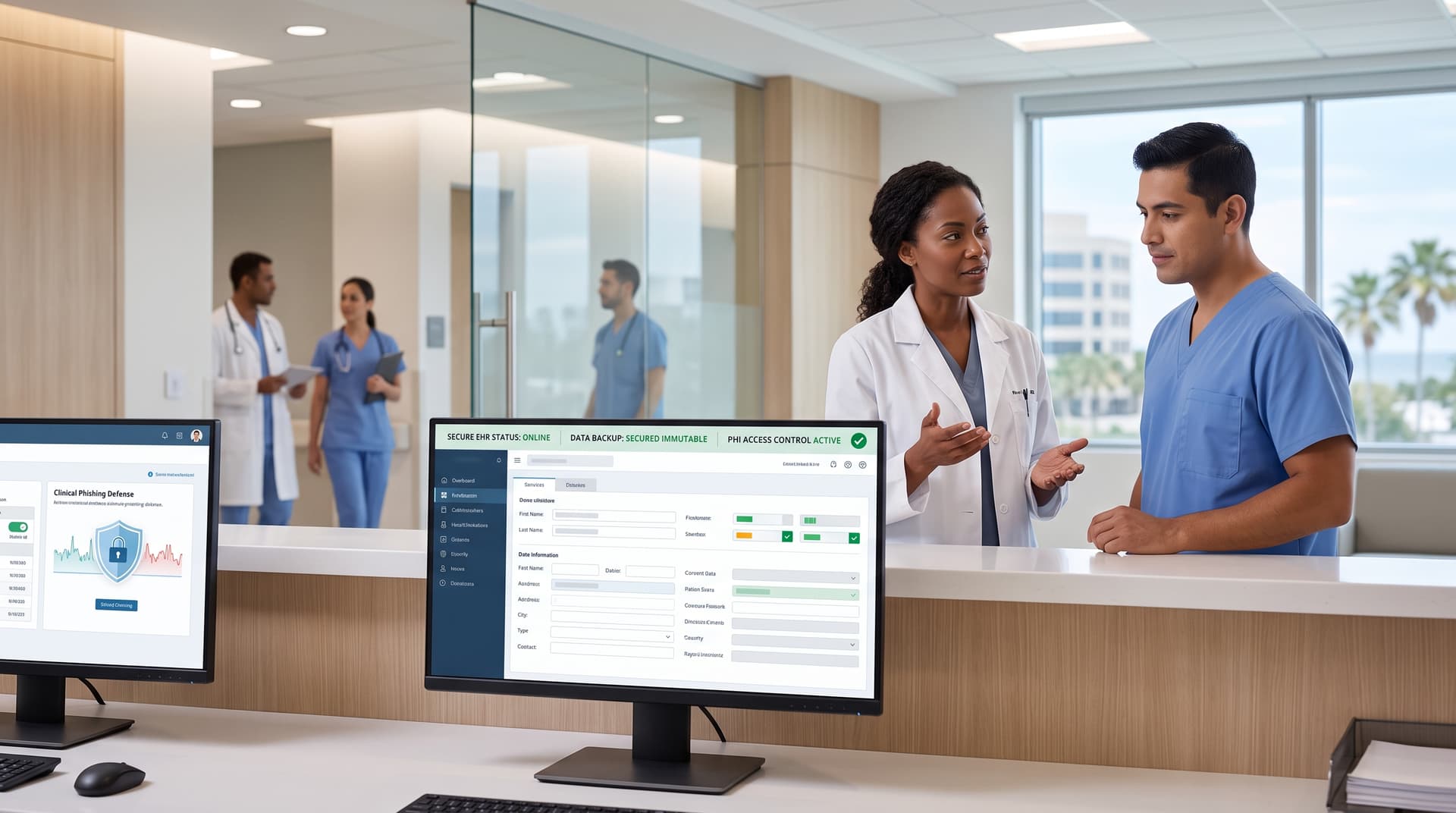
In healthcare environments across Florida—from fast-growing clinical networks in Tampa Bay to outpatient surgical centers along the Suncoast—technology infrastructure is directly tied to patient care quality. When an Electronic Health Record (EHR) system experiences latency or downtime, clinical workflows grind to a halt, appointment schedules fall behind, and patient satisfaction drops. At the same time, administrative and clinical leadership must maintain strict adherence to HIPAA Security and Privacy Rules.
Achieving seamless clinical operations while protecting Protected Health Information (PHI) requires a deliberate, defense-in-depth technical architecture. Below is an operational blueprint designed for practice administrators, compliance leads, and clinical operations managers.
1. High-Availability EHR Infrastructure and Continuity
Clinical teams rely on uninterrupted access to chart notes, lab results, and e-prescribing modules. System outages put patient safety at risk and create massive backlogs in clinical documentation.
- Redundant Network Paths: Implement dual-WAN connections with automatic failover (such as fiber paired with high-speed cellular or satellite) so internet disruptions do not take down cloud-hosted EHR portals.
- Local Caching & Offline Modes: Ensure hybrid or self-hosted EHR systems maintain local cache capabilities during transient connectivity drops.
- Disaster Preparedness: For practices operating in tropical weather zones like Tampa Bay, local power disruptions and severe storms require automated cloud failover protocols to maintain care continuity during regional emergencies.
2. Granular PHI Access Controls & Identity Management
Protecting patient records requires enforcing strict administrative and technical safeguards around identity verification and access permissions.
- Role-Based Access Control (RBAC): Restrict PHI access strictly based on clinical necessity. Physicians, triage nurses, billing specialists, and front-desk coordinators should only see the specific modules required for their roles.
- Multi-Factor Authentication (MFA): Enforce phishing-resistant MFA across all endpoint logons, remote desktop sessions, and cloud EHR software.
- Session Timeouts & Automatic Locking: Configure workstations in patient exam rooms and shared nurse stations to lock automatically after short periods of inactivity to prevent unauthorized viewing.
3. Vendor Risk Oversight and BAA Management
Under HIPAA guidelines, any third-party vendor handling, transmitting, or storing PHI on behalf of a covered entity must sign a Business Associate Agreement (BAA). However, executing a BAA is merely the administrative baseline.
- Technical Auditing: Verify that vendor systems enforce encryption at rest (AES-256) and in transit (TLS 1.3).
- Continuous Monitoring: Conduct annual risk assessments and automated vulnerability scans on all third-party integrations, API endpoints, and cloud storage repositories.
- Lifecycle Asset Tracking: Maintain an up-to-date inventory of all software vendors, medical IoT devices, and external contractors with active system credentials.
4. Ransomware Protection with Immutable Backups
Healthcare remains a top target for cyber extortion due to the urgent necessity of continuous data access. Standard backups are no longer sufficient if attackers can compromise backup servers and encrypt those files as well.
- Air-Gapped & Immutable Copies: Deploy write-once-read-many (WORM) immutable backup architecture. Even if administrative credentials are compromised, immutable backup snapshots cannot be altered, overwritten, or deleted during a retention window.
- Rapid Recovery Testing: Perform routine disaster recovery drills to measure Recovery Time Objectives (RTO) and Recovery Point Objectives (RPO), ensuring clinical operations can restore systems within acceptable operational windows.
5. Mitigating Phishing and Human Risk in Clinical Workflows
Clinical staff work in high-stress, fast-paced environments where tricking a nurse or medical assistant into clicking a malicious link is a primary attack vector for cybercriminals.
- Contextual Security Training: Deliver brief, regular micro-learning modules tailored to healthcare scenarios (e.g., fake diagnostic lab notifications or urgent fax alerts) rather than generic corporate training.
- Streamlined Incident Reporting: Provide a single-click button within staff email clients so employees can immediately report suspicious emails to internal IT without disrupting patient consultations.
- Zero Trust Network Access (ZTNA): Segment guest Wi-Fi networks completely away from clinical equipment and internal medical record servers.
Build a Resilient, HIPAA-Aligned Technical Foundation
Balancing rigorous data privacy requirements with seamless, low-latency clinical workflows does not have to be a trade-off. By establishing resilient infrastructure, strict access management, and immutable data protection, practice leaders can focus on delivering exceptional patient care.
Is your organization prepared for the evolving regulatory and security landscape? Request a HIPAA-aligned IT assessment from Bitscaled to review your current EHR architecture, backup readiness, and network controls.