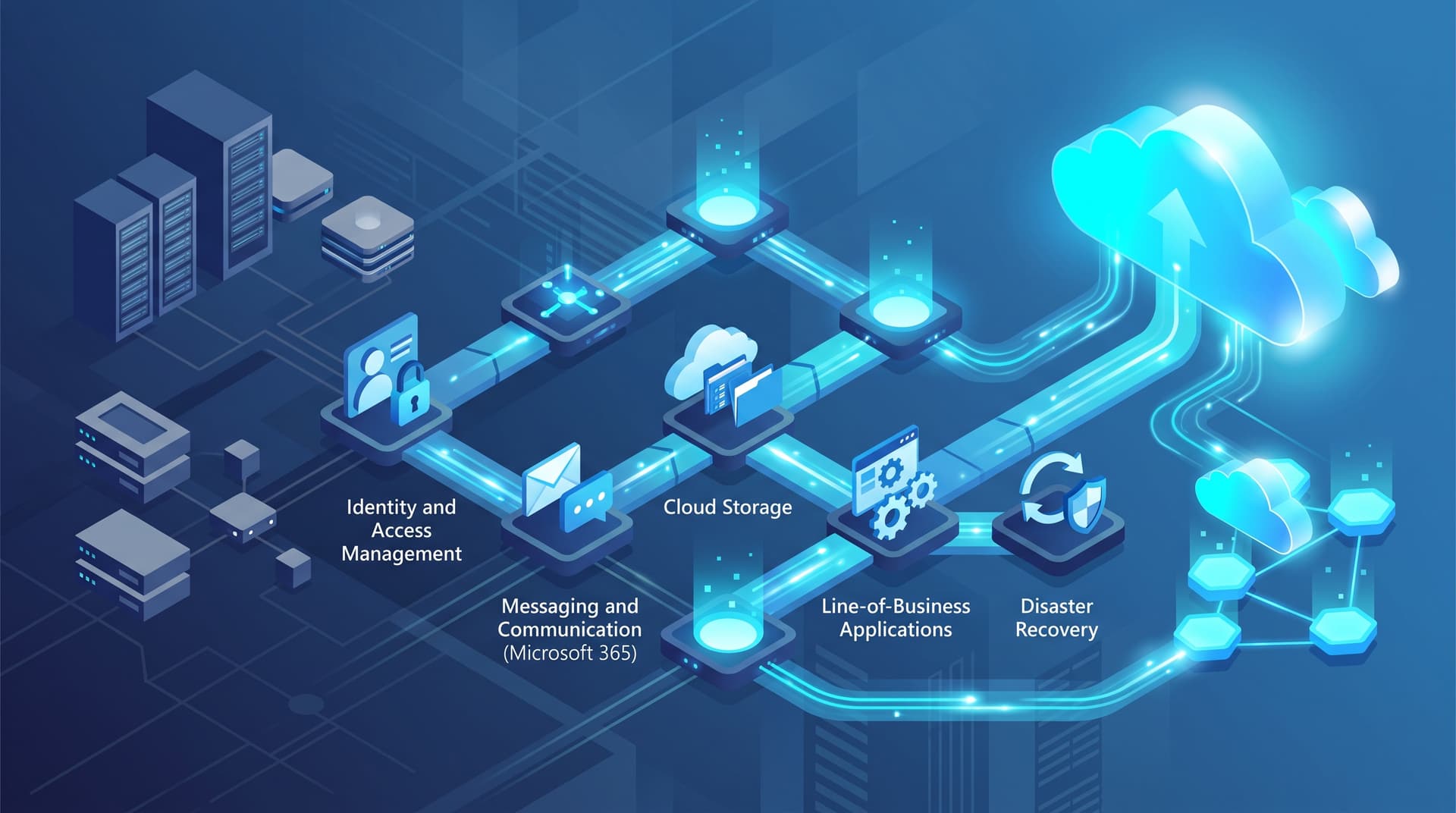
For small and medium-sized businesses (SMBs), moving to the cloud is rarely a single weekend event. It is a phased journey that requires balancing legacy systems with modern capabilities. Through our Bitscaled Cloud Infrastructure services, we help IT managers navigate the complexities of cloud migration and hybrid cloud operations, ensuring secure, business-outcome-focused transitions to Microsoft 365 and Azure.
The Optimal SMB Migration Sequence
Executing a migration in the wrong order can lead to authentication failures, broken integrations, and user frustration. A proven sequence minimizes friction:
- Identity: Establish Microsoft Entra ID (formerly Azure AD) as your foundational identity plane. Integrating on-premises Active Directory enables Single Sign-On (SSO) and sets the stage for zero-trust security.
- Email: Migrate from on-premises Exchange or legacy providers to Exchange Online. This is often the highest-visibility workload and delivers immediate reliability improvements.
- File Services: Transition traditional file servers to SharePoint Online, OneDrive for Business, and Azure Files. This phase eliminates VPN dependencies for remote workers.
- Line-of-Business (LOB) Apps: Rehost or refactor legacy LOB applications into Azure Virtual Machines (IaaS) or App Services (PaaS).
- Disaster Recovery (DR): Modernize your DR posture using Azure Site Recovery and immutable cloud backups to protect newly migrated and remaining hybrid assets.
Navigating Common Hybrid Pitfalls
Operating in a hybrid state introduces unique risks. Avoid these common traps:
- Stale AD Sync: Neglecting Azure AD Connect (Entra Connect) can cause password sync failures and delayed offboarding of compromised accounts. Monitor sync health diligently.
- Overshared M365 Permissions: When file services are "lifted and shifted" without redesigning permissions, flat folder structures often lead to massive oversharing in Teams and SharePoint.
- Undocumented DNS Cutovers: Rushed migrations frequently ignore the complexities of DNS. Failing to document and lower TTLs for MX records, Autodiscover, SPF, and DKIM ahead of cutover can result in lost emails and degraded deliverability.
Phased Roadmap and Risk Mitigation
| Phase | Workload | Rollback / Mitigation Strategy |
|---|---|---|
| Phase 1 | Identity & Security | Maintain local AD as authoritative; run Entra Connect in staging mode first. |
| Phase 2 | Lower DNS TTLs to 5 minutes 48 hours prior; use pilot groups for validation. | |
| Phase 3 | Files & Intranet | Keep local file shares in read-only mode during initial user adoption. |
| Phase 4 | LOB Applications | Build parallel Azure environments; route test traffic before full DNS cutover. |
Always maintain a documented rollback plan. Reducing DNS Time-To-Live (TTL) values days in advance allows for rapid reversion if a workload fails post-migration. Additionally, utilizing pilot groups ensures that unexpected application behaviors are caught before a company-wide rollout.
Next Steps
Successful cloud migrations require meticulous planning and deep architectural awareness. Schedule a cloud readiness review with Bitscaled before your next migration phase to ensure your identity, security, and infrastructure are aligned for success.