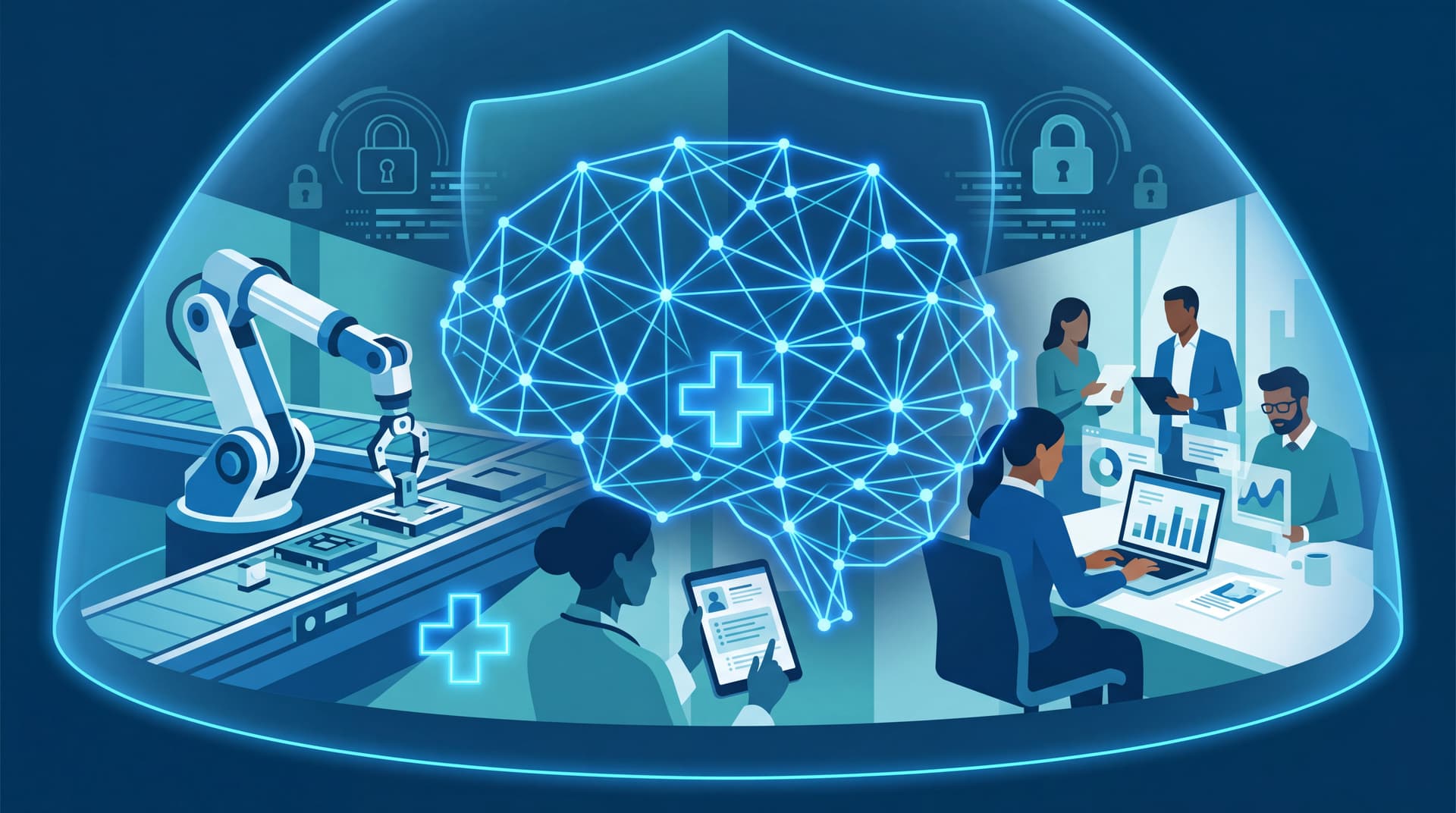
Beyond the Hype: Practical AI and RPA Implementation for SMBs
Artificial intelligence and automation have moved decisively past the experimental phase. For small to medium-sized businesses (SMBs) in healthcare, manufacturing, and professional services, AI-powered workflow automation and Robotic Process Automation (RPA) are now essential tools for maintaining competitiveness. However, deploying these technologies requires a strategic approach that balances operational efficiency with robust security.
Transforming Healthcare with Intelligent Process Automation
In the healthcare sector, administrative burden is a primary driver of burnout and operational inefficiency. Intelligent Process Automation (IPA) allows clinics and medical practices to streamline patient intake, insurance verification, and billing workflows. By integrating machine learning models with existing Electronic Health Record (EHR) systems, healthcare SMBs can automatically flag coding errors and accelerate claims processing. Crucially, these automated workflows reduce human error, allowing staff to focus entirely on patient care and clinical outcomes.
Elevating Manufacturing Through RPA and Machine Learning
Manufacturing and logistics SMBs operate on tight margins where efficiency is paramount. RPA is transforming operations by connecting disparate systems and streamlining repetitive tasks. Key applications include:
- Predictive Maintenance: Machine learning applications analyze historical production and sensor data to enable predictive maintenance, minimizing costly equipment downtime.
- Supply Chain Forecasting: AI-driven decision making provides real-time supply chain forecasting, helping manufacturers dynamically adjust to material shortages or demand spikes.
- Back-Office Automation: RPA automates inventory management, order processing, and supplier communications to accelerate the manufacturing lifecycle.
Streamlining Professional Services with AI-Driven Workflows
For professional services firms—ranging from legal practices to financial consultancies—time is the primary commodity. AI-powered document processing can extract key clauses from contracts or synthesize financial data in seconds. Furthermore, intelligent resource management tools can predict project timelines and automate client onboarding procedures, ensuring a frictionless experience that enhances client retention and firm profitability.
Securing the AI Frontier: Zero Trust and Azure M365
The integration of AI and automation introduces new vectors for data exposure. Feeding proprietary business data or sensitive Protected Health Information (PHI) into machine learning models demands a rigorous security framework. This is where a Zero Trust architecture becomes non-negotiable.
By leveraging Azure and Microsoft 365 security frameworks, SMBs can safely adopt AI. Microsoft Entra ID ensures that only verified users and automated service principals can access critical data repositories. Meanwhile, Microsoft Purview provides information protection and Data Loss Prevention (DLP), ensuring that sensitive data is encrypted and cannot be inadvertently leaked by AI tools. Implementing Zero Trust means that every automated transaction and AI query is explicitly verified, granting SMBs the confidence to innovate without compromising regulatory compliance.
Conclusion
Strategic automation is no longer reserved for enterprise-level organizations. By adopting RPA, machine learning, and intelligent workflows within a secure, Zero Trust environment, SMBs can unlock unprecedented productivity and scale their operations effectively.
Ready to integrate secure AI and automation into your business operations? Book a discovery call with Bitscaled today to build your customized technology roadmap.