SMB Cloud Transition Framework: Migration Order, Hybrid Governance, and Rollback Strategy
Migrating an SMB environment to the cloud requires more than moving virtual machines—it demands a disciplined operational sequence to prevent service downtime, security exposure, and user friction. When transitioning to a hybrid cloud or full Microsoft 365/Azure footprint, improper staging frequently causes authentication failures and compliance breaches.
To achieve a predictable transition, IT leadership must sequence workloads logically, mitigate known hybrid friction points, and maintain deterministic rollback capabilities.
The 5-Stage SMB Migration Sequence
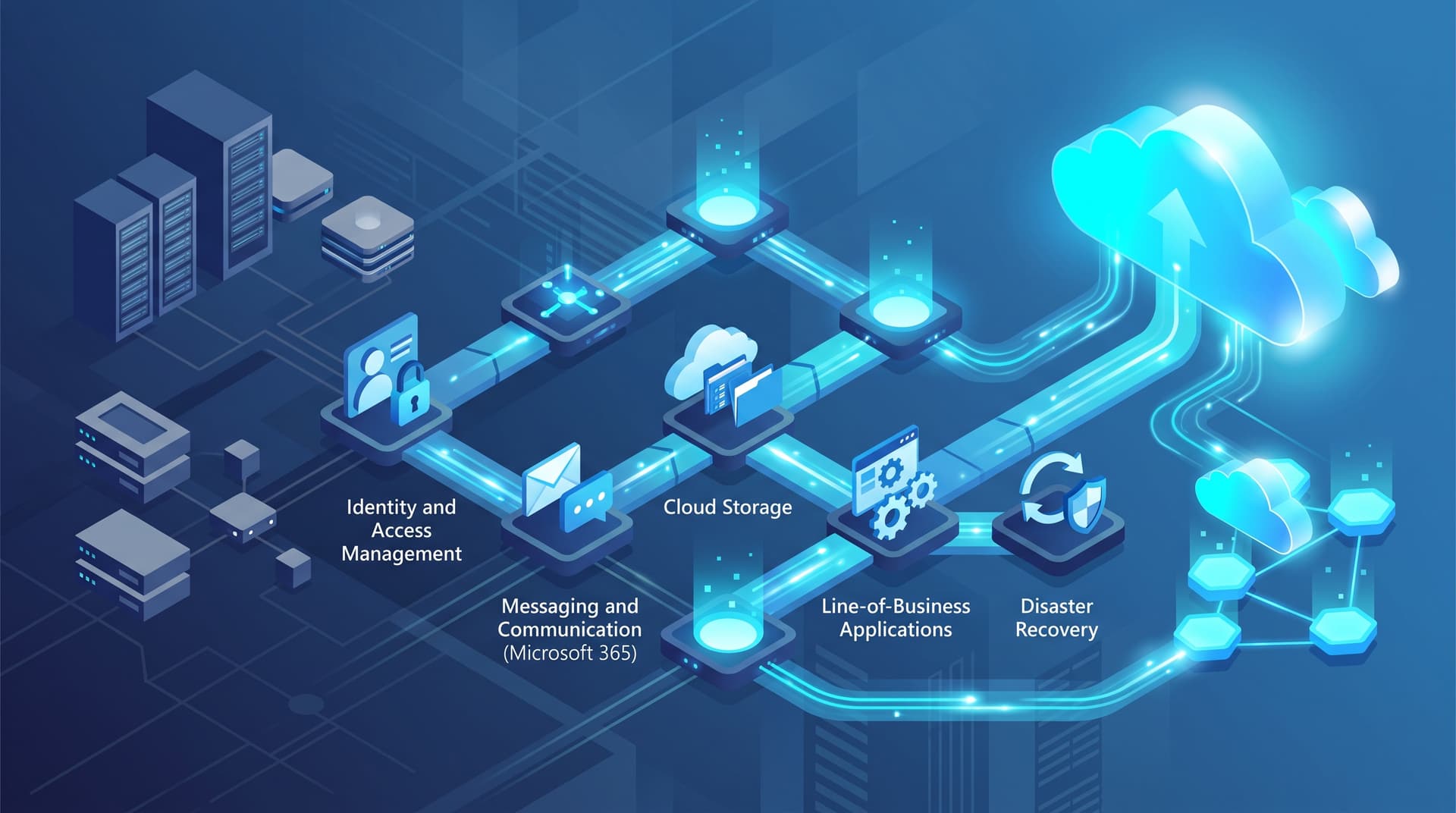
Executing migrations in the correct order minimizes operational dependency locks. Bitscaled recommends the following sequence for SMB environments:
- Identity & Authentication: Establish Azure AD (Entra ID) sync, enforce MFA, and normalize directory objects before moving data.
- Email & Messaging: Migrate Exchange mailboxes to Microsoft 365, ensuring autodiscover and MX records align with modern security standards.
- File Services & Unstructured Data: Transition legacy file servers to SharePoint Online, OneDrive, and Azure Files with cleaned permissions.
- Line-of-Business (LOB) Applications: Re-host or refactor core business applications, shifting database loads to Azure SQL or IaaS instances.
- Disaster Recovery & Business Continuity: Modernize backup targets, configure Azure Site Recovery, and decommission legacy on-premises DR infrastructure.
Common Hybrid Operational Pitfalls
During hybrid coexistence, subtle misconfigurations create operational debt and vulnerability windows.
Stale Active Directory Synchronization
Failing to prune inactive, orphaned, or unmapped objects prior to Azure AD Connect sync leads to identity sprawl and license waste. Ensure OU filtering is strictly enforced and duplicate user attributes are resolved prior to initial tenant provisioning.
Overshared Microsoft 365 Permissions
Bulk migration of local file shares often carries over loose NT File System (NTFS) access policies into SharePoint and Teams. Conduct automated permission audits prior to cutover to avoid broad public sharing defaults across critical directories.
Undocumented DNS Cutovers
Uncoordinated changes to external CNAME, MX, and SPF/DKIM records remain a primary cause of post-migration email deliverability failures and service downtime. Always document TTL reductions at least 48 hours in advance of cutover windows.
Phased Migration Roadmap & Risk Mitigations
| Phase | Target Scope | Primary Technical Deliverable | Rollback & Risk Mitigation Strategy |
|---|---|---|---|
| Phase 1 | Identity & MFA | Entra ID Sync & Conditional Access | Maintain local Active Directory as source of truth; pause delta sync if directory corruption occurs. |
| Phase 2 | Messaging | Exchange Online Cutover / Hybrid | Keep on-premises Exchange receiving via dual delivery until DNS MX cutover is verified. |
| Phase 3 | Content & Files | SharePoint Online & Azure Files | Retain read-only local share access during seed and delta syncs; roll back drive mappings if needed. |
| Phase 4 | LOB Workloads | Azure IaaS / PaaS Deployment | Utilize Azure VM restore points and database point-in-time restores; retain on-premises host images for 30 days. |
| Phase 5 | DR & Decommission | Azure Backup & Site Recovery | Conduct full failover test prior to final on-premises hardware wipe and hypervisor host teardown. |
Ensuring Rollback Viability
A successful cloud migration strategy includes a non-negotiable rollback blueprint. Every migration phase must have pre-defined trigger thresholds, clear rollback windows, and verified backup states. Never proceed to host decommissioning until all post-cutover validation checks pass and data integrity is verified across business units.
Accelerate Your Cloud Journey
Navigating cloud infrastructure requires architecture-aware planning and methodical execution. Bitscaled Cloud Infrastructure services helps SMBs modernize without unnecessary downtime or operational risk.
Schedule a cloud readiness review with Bitscaled before your next migration phase.