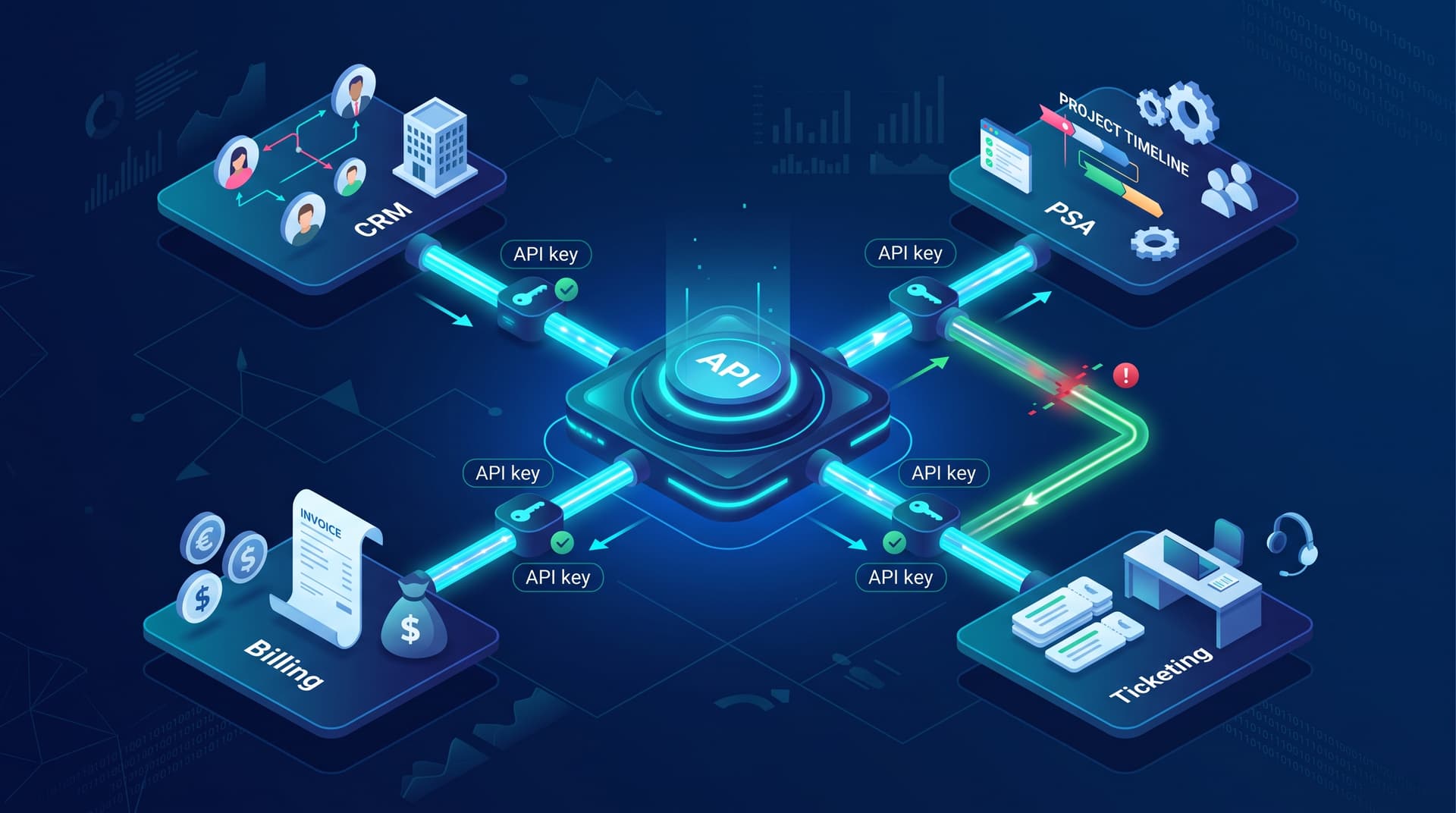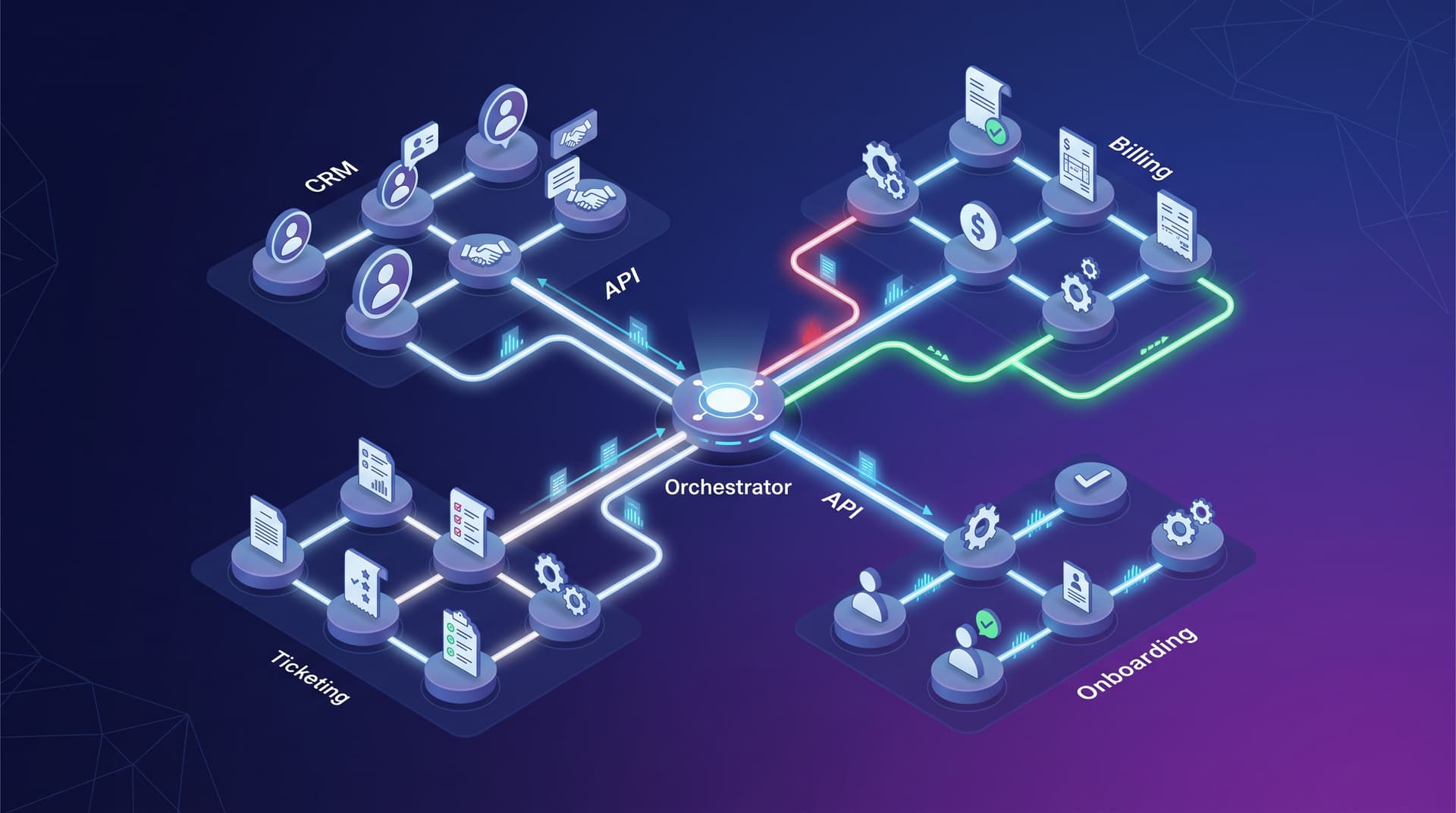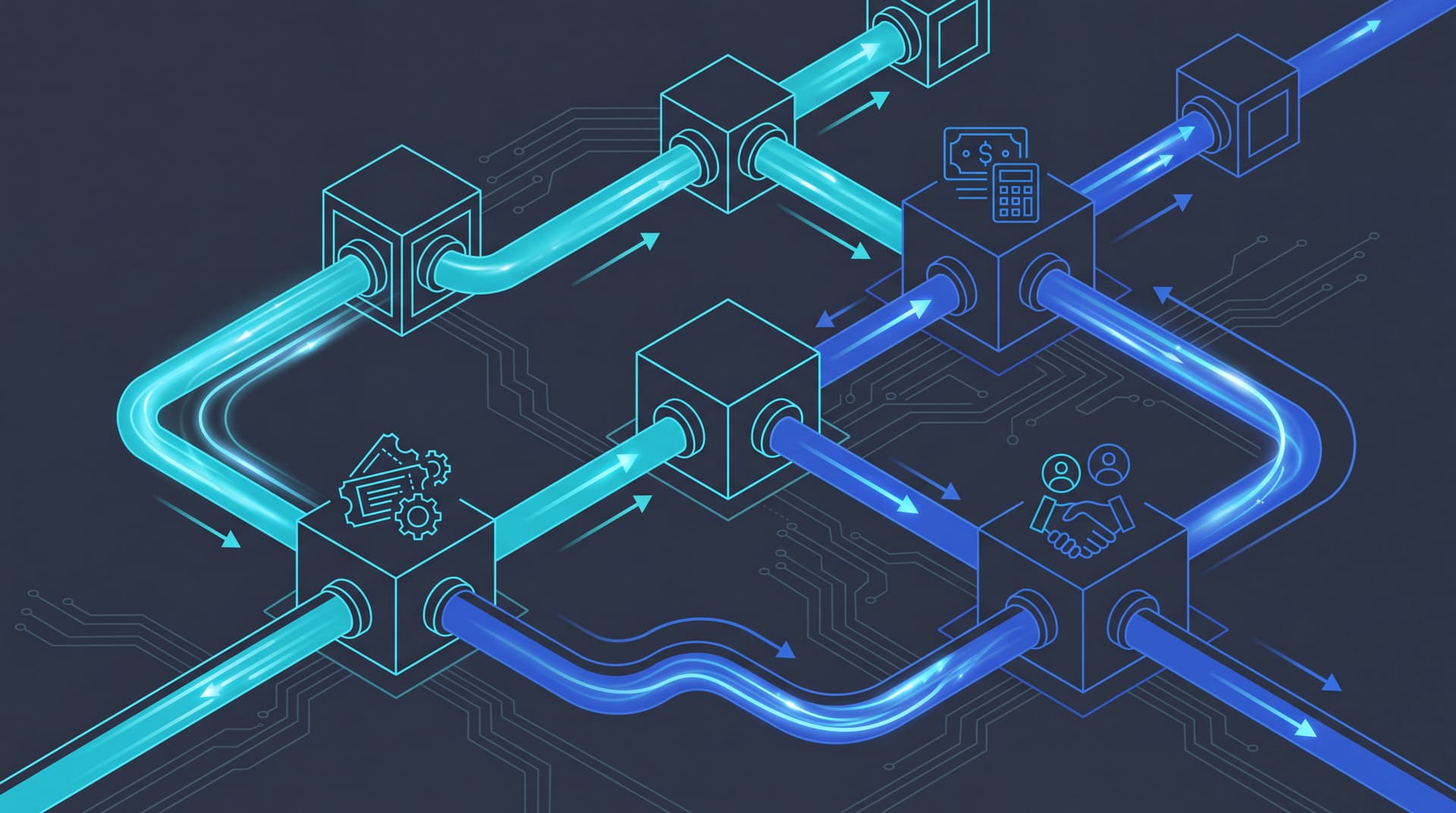
Modern enterprise operations depend on an expanding web of specialized platforms—from Professional Services Automation (PSA) engines and CRMs to financial ledgers and identity providers. When these systems operate in isolation, friction accumulates quickly. Achieving seamless cross-system orchestration requires moving beyond basic point-to-point scripts toward resilient, systems-aware workflow automation.
API-Based Orchestration vs. UI Bots (RPA)
When bridging disparate software, architecture teams typically evaluate two primary approaches: direct API-based orchestration or UI-driven Robotic Process Automation (RPA).
- API-Based Automation: Interacts directly with platform endpoints using structured payloads (JSON/XML). It operates at the application logic layer, yielding high execution speeds, deterministic performance, explicit versioning, and minimal maintenance overhead.
- UI Bots (RPA): Simulate human keystrokes and visual clicks on front-end interfaces. While useful for legacy applications lacking accessible endpoints, UI bots are inherently brittle. Minor DOM updates, layout changes, or network latency spikes frequently break automation flows.
For enterprise-grade orchestration, an API-first methodology serves as the foundation, reserving UI bots strictly as a last resort for disconnected legacy infrastructure.
Ensuring System Resilience via Idempotency
In cross-system workflows, network timeouts and transient API errors are inevitable. A robust orchestration model must be idempotent—meaning executing an automated process multiple times produces the exact same system state as executing it once.
Without idempotency, automated retries after a network blip can cause severe operational issues, such as duplicate invoice generation or redundant customer records. Implementing idempotency involves:
- Deterministic Unique Keys: Generating unique payload identifiers (e.g., hash of ticket ID and timestamp) passed to downstream APIs.
- State Verification: Checking whether a target record already exists before issuing creation requests.
- Transactional Boundary Logging: Maintaining a central audit store that tracks execution state across multi-step transactions.
Actionable Failure Handling & Automated Notifications
Automations should fail gracefully and noisily when unhandled edge cases occur. Rather than allowing silent drop-offs, enterprise orchestration frameworks implement dead-letter queues and automated failure routing.
When an endpoint returns a persistent error (such as a 4xx validation failure or 5xx server outage after exponential backoff retries), the orchestration platform must automatically:
- Pause downstream actions in the impacted execution branch.
- Log contextual payloads and error diagnostics to a central monitoring log.
- Dispatch real-time, targeted alert notifications (via Webhooks, Teams/Slack channels, or high-priority IT tickets) to technical owners for swift remediation.
Real-World Multi-System Scenario: Ticketing, Billing, and Onboarding
Consider an end-to-end operational workflow connecting PSA, billing, and onboarding stacks:
- Ticketing Trigger: A service engineer resolves an onboarding ticket in the PSA. The event emits a webhook payload containing billable line items and customer parameters.
- Billing Engine Synchronization: The orchestrator captures the webhook, generates an idempotent transaction key, and creates a pending invoice in the accounting engine. If the billing API experiences a temporary hiccup, the retry mechanism uses the same key to prevent duplicate invoicing.
- Automated Onboarding Sequence: Upon billing validation, the orchestrator triggers automated provisioning across identity managers (e.g., Entra ID) and line-of-business tools, sending account credentials securely to the client contact.
- Failure Exception Handling: If identity provisioning fails due to a domain naming collision, the orchestrator flags the exact step, halts account notification, and creates a high-priority task in the operations queue while notifying administrators.
Building Resilient Operations
Transitioning from fragmented tools to unified cross-system workflow automation unlocks immediate operational momentum while reducing risk.
Map your highest-friction workflows with Bitscaled automation architects.