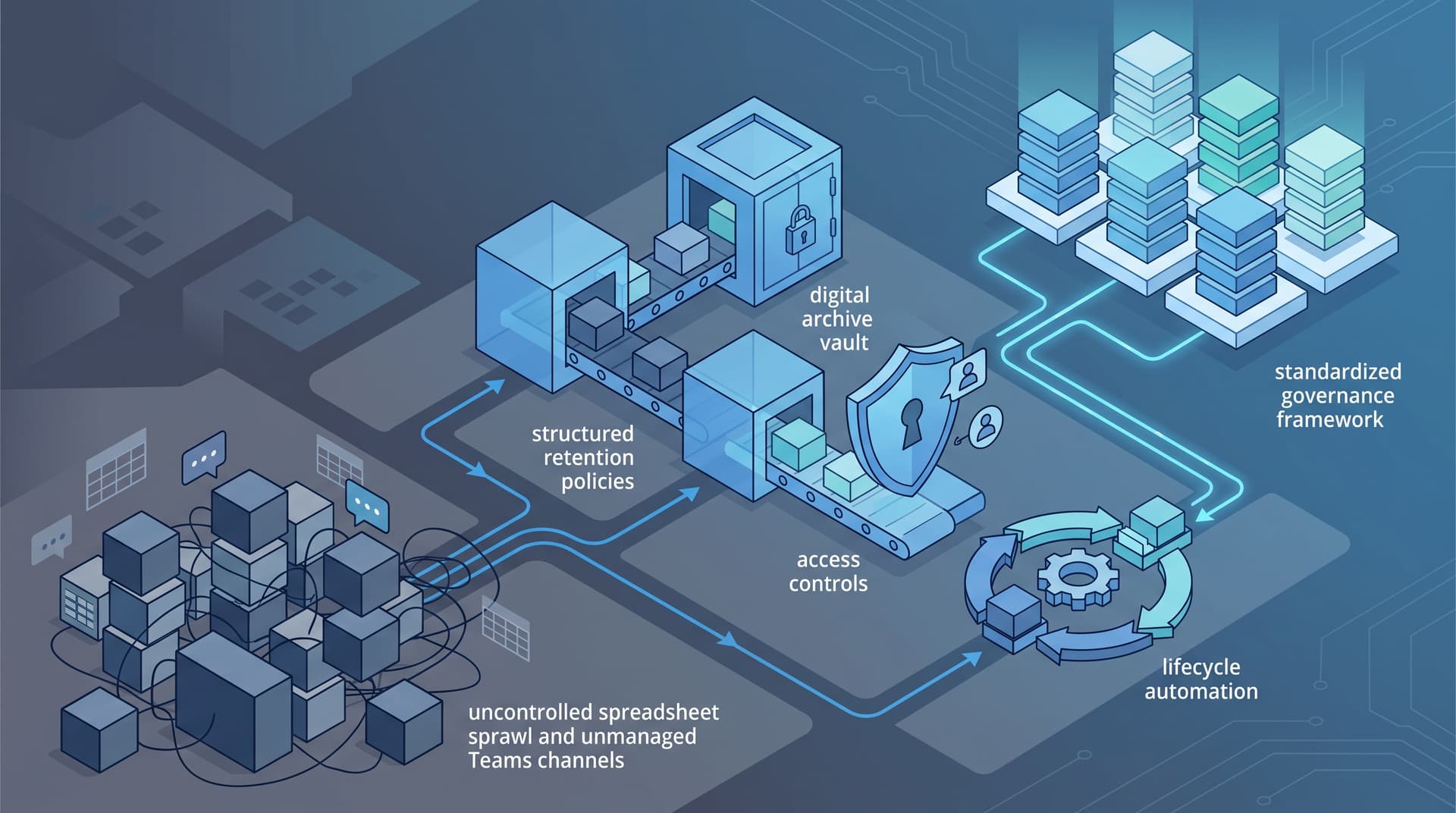
The Hidden Risk of Unmanaged Operational Data
Finance and operations teams often operate at the center of critical business data. Over time, daily workflows generate thousands of ad-hoc spreadsheets, local data extracts, and temporary Microsoft Teams channels. What begins as agility quickly degrades into data sprawl, creating version ambiguity, elevated security risk, and unnecessary storage overhead.
Operational data hygiene is the systematic management of data throughout its entire lifecycle. By establishing clear retention schedules, access classifications, backup boundaries, and platform controls, organizations transform messy file repositories into resilient, auditable data assets.
1. Establishing Enforceable Retention Policies
Without explicit retention policies, data accumulates indefinitely. Finance departments frequently keep legacy financial models and raw transaction dumps long after their operational utility or regulatory requirements have expired.
Effective retention management requires three primary actions:
- Define Lifecycle Rules by Category: Distinguish between permanent corporate records, temporary working drafts, and transient operational logs.
- Automate Expiration and Archiving: Implement automated retention labels within cloud workspaces to enforce deletion or immutable archiving after designated timeframes.
- Reduce Stale Data Exposures: Systematically purging obsolete records minimizes the surface area exposed in the event of a security incident.
2. Implementing Granular Access Classification
Broad access permissions are a common failure point in rapid-growth environments. Sensitive financial reports and customer operational data often reside in loosely protected shared folders.
Achieving operational excellence requires a strict zero-trust, least-privilege access model:
- Data Classification Labels: Categorize documents as Public, Internal, Confidential, or Restricted based on business impact.
- Role-Based Access Control (RBAC): Restrict access according to job function rather than individual requests, preventing permission creep.
- Regular Access Reviews: Conduct quarterly audits to revoke permissions for departed employees or changed job roles.
3. Defining Precise Backup Scope & Recovery Boundaries
Cloud synchronization tools like OneDrive or SharePoint provide file availability, but synchronization is not a substitute for comprehensive backup governance. If a spreadsheet is corrupted, overwritten, or encrypted by ransomware, sync tools propagate the damage instantly.
Organizations must establish clear backup scopes:
- Separate Workloads from Archives: Ensure primary financial databases and core collaboration portals are backed up to isolated, immutable storage targets.
- Define Recovery Time Objectives (RTO): Know exactly how quickly critical operational workbooks can be restored during an outage.
- Validate Recovery Integrity: Test backup restores on a regular schedule rather than assuming sync status equals recoverability.
4. Containing SharePoint and Microsoft Teams Sprawl
Microsoft Teams and SharePoint allow fast collaboration, but self-service creation without guardrails leads to duplicate channels, orphan sites, and fragmented communication.
To restore structural clarity:
- Standardize Site Provisioning: Require approval workflows or template-driven creation for new Teams and SharePoint sites.
- Automate Inactivity Monitoring: Flag and archive channels or sites that have had no user activity for 90 days.
- Consolidate Single-Source-of-Truth Libraries: Centralize financial reporting into locked, authoritative document libraries to eliminate localized Excel forks.
5. Strengthening Cyber Insurance and Compliance Posture
Insurance underwriters and compliance auditors increasingly inspect how organizations manage data lifecycle risks. Demonstrating rigorous data hygiene directly supports organizational governance during these reviews.
While specific requirements vary by framework and carrier, strong hygiene practices support compliance in key ways:
- Demonstrating Data Minimization: Lowering stored volume reduces exposure severity on cyber insurance risk questionnaires.
- Auditable Access Histories: Access logs and classification policies provide transparent proof of administrative control.
- Consistent Enforcement: Automated retention demonstrates proactive risk management rather than reactive cleanup.
Take Control of Your Data Infrastructure
Operational data hygiene transforms unstructured, risky file ecosystems into predictable, governed business environments. By combining structured retention schedules with automated platform controls, finance and operations leaders can eliminate spreadsheet chaos and secure critical records.
Assess your data lifecycle and retention posture with Bitscaled.